Needs and baseline studies
Understand household realities, farm conditions, water access, energy use, climate risks, livelihood gaps, and institutional capacity.
Research & innovation
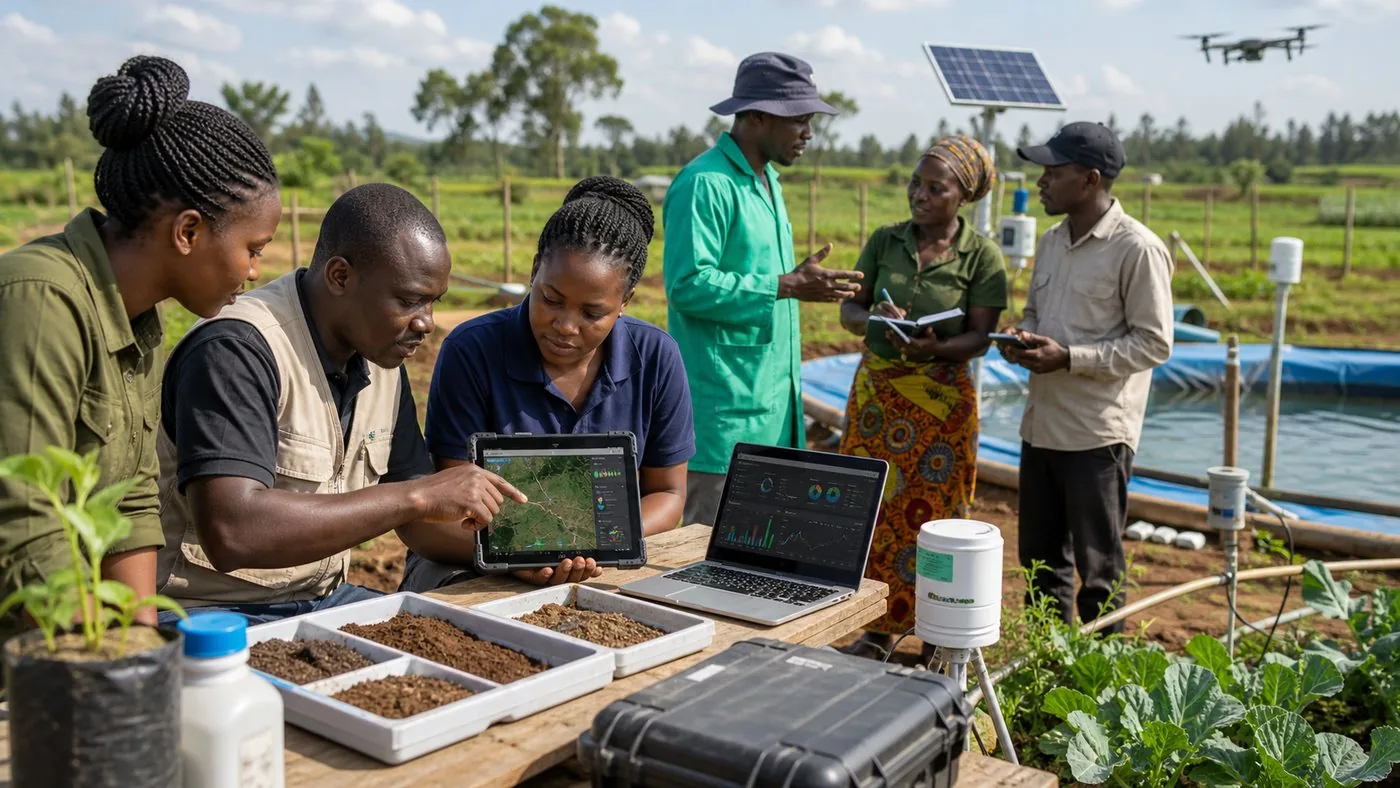
We use community needs assessments, feasibility studies, field trials, AI, GIS, soil science, monitoring, and simple technologies to make development programs measurable, local, and scalable.
Research framework
Understand household realities, farm conditions, water access, energy use, climate risks, livelihood gaps, and institutional capacity.
Run practical trials for SmartFarm, SmartFishAI, soil health, irrigation, aquaculture, solar systems, clean cooking, waste recovery, and community training models.
Turn field data into maps, soil guidance, crop advisories, fish-water alerts, project indicators, energy models, water-system insights, and partner-ready learning products.
Track what changes, document lessons, adapt implementation, and prepare evidence that can support funding and scale-up decisions.
Applied research
EarthGuard documents local knowledge, collects field data, tests appropriate technologies, and shares lessons with communities, government agencies, universities, donors, and development partners.
Technology tools
Moisture-aware irrigation and fertigation planning linked to soil sensors, weather forecasts, solar pumping, and farm dashboards.
A localised innovation combining AI, GIS, and soil science to provide farmers with actionable soil health data and field-specific recommendations.
Water temperature, dissolved oxygen, pH, salinity, turbidity, ammonia, and water-level checks for ponds, cages, aquaponics, boreholes, and water access projects.
Tracking water catchment conditions, forest-region pressures, tree survival, soil erosion, and community restoration progress.
Mapping waste hotspots, tracking recycling participation, and measuring cleanup impact for schools and community groups.
Project performance, training progress, and community indicators.
Mobile farmer advisory messages and group coordination.
Structured collection for surveys, monitoring, and reporting.
Monitoring solar dryers, pumps, and energy-saving systems.
Estimating solar demand, pump sizing, household energy savings, and clean technology performance before projects are installed.
Supporting automated pumping, tank-level monitoring, flow control, and maintenance planning for reliable community water systems.